Natural resources
Kocani Valley is the largest thermal basin of high temperature waters in the Balkan Peninsula. In the vicinity of Kocani so far 18 holes have been made, of which 14 are self-flowing. Water horizons occur at a depth of 86 to 1096 m, with a capacity of 2.2 to 350l / sec and a temperature of 50 to 80°C. Thermal springs appear in the villages of Dolni Podlog and Banja, whereby two holes with a depth of 35 and 460 metres are used at Dolni Podlog, with a capacity of 300 l / sec and an average temperature of 78°C. In the village of Banja there are self-flowing thermal waters with a capacity of 30 l / sec and a temperature of 63°C.
Lakes
Lake Gratche is a small artificial accumulation in the immediate vicinity, built on the Kocani River in 1959 at the foot of the Osogovo Mountains. Beside the lake, there are modern tourist and catering facilities. Situated in a beautiful picturesque gorge, Gratche is a very popular site for recreational and picnic tourism.
Mountains
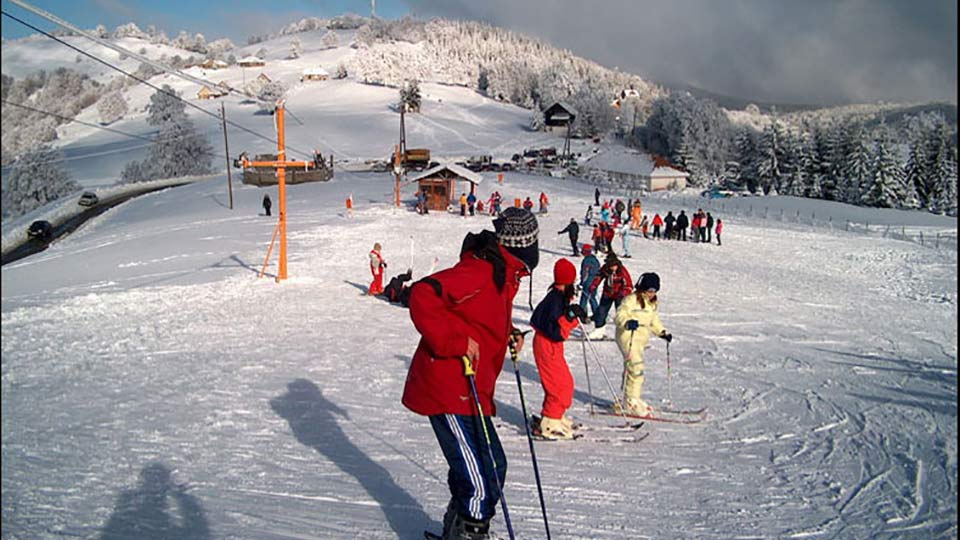
Ponikva one of the most famous winter tourist centres and weekend settlements in Macedonia. Ponikva is located near Kocani, at an altitude of 1,560 metres in a region with dense beech forest and diverse vegetation of the Osogovo Mountains. The sports and recreation centre includes two ski lifts, weekend houses, auto camps, bungalows, daily supply facilities, multipurpose spaces, sports and recreation grounds, catering facilities, servicing and services for ski equipment.
Natural beauties, ecologically clean setting and favourable climate are excellent preconditions for the great attendance of Ponikva. As a special tourist attraction for lovers of hunting, in the vicinity of Ponikva there is a wildlife reserve. The commercial hunting-reserve, in addition to accommodation, offers visitors the possibility of hunting does, deer, Dama dama, mouflons, wild boars.
Culture and history of the city of Kocani
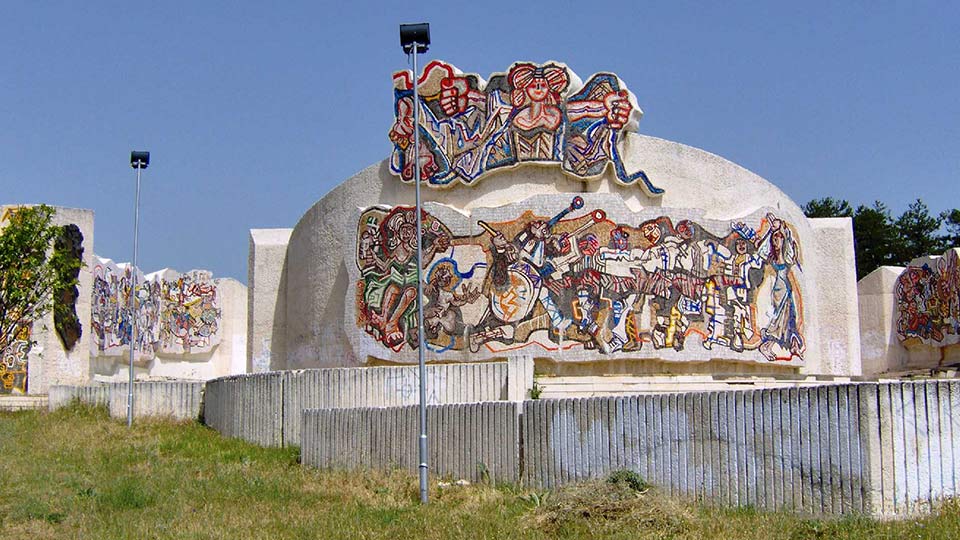
The monument of Freedom in Kocani was built between 1975 and 1977. The artistic-architectural solution is the work of Gligor Cemerski and Radovan Radjenovic. The monument was completely finished and handed over in 1981. It was made in a specific form of architectural plastic and a modified form of an open basilica. The mosaic display of 335 m crowned and perpetuated historical struggle of the Macedonian people for freedom from the Ilinden period to the Second World War. The names of the killed fighters from Kocani and the region are engraved in the monument with a special piety. Besides the historical and artistic value, the complex has a usable value with the built amphitheatral scene. It was declared a cultural monument and entered into the Register of Protection of Monuments of Culture.
Archaeology in Kocani
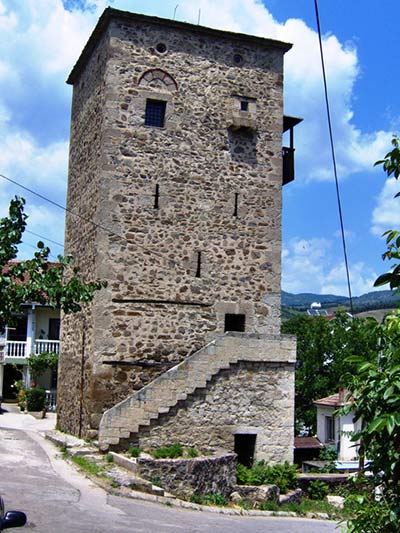
The archeological site Morodvis is a treasure of valuable objects from different cultures. From the time of Justinian I to the present, Morodvis is a settlement in the Kocani Valley, where several archaeological sites are located. One of them is the Gradishte site, a fortified settlement from late antiquity and the middle ages on the elevated area to the south of Morodvis. It is a rectangular cistern, under which the church St. Simeon was built. The second site near Kocani is the Grobjani Rid, a medieval building and a necropolis. Then, Crkviste Morobizdon, a late antique and medieval complex of several sites, where a representative church with a walled fence was discovered. Here was the church centre in the Bregalnica region. The oldest of the four found churches of Crkviste dates back between the 5th and the 6 th century, and the more recent one to the 16 th century. The other two churches are from the 11 th and 13th century.
Cultural manifestations
The cultural manifestation “Days of rice” in Kocani is a significant tourist event. It is dedicated to Kocani’s “white gold”, filled with a series of festivities and festivals at the beginning of the harvest of rice in the region of Kocani. The production of rice and the method of its production are a special attraction for people who see it for the first time. It’s an extraordinary experience, since in a few locations in Southern Europe, rice is grown as a culture. Kocani’s rice is connected with numerous gastronomic specialties, characteristic of the Kocani valley.