



31 Mar Education is the basis for the development of every country
Low inflation is healthy, but at a level close to 0 percent inflation, the economy of a country like Macedonia is unlikely to grow. Therefore, in many European countries, inflation levels between 2 and 7 percent are considered ideal, says in an interview for Tourism and Management Magazine, Said Sergio Mousagi, political and strategic consultant and recipient of the honorary title “Doctor Honoris Causa” of UTMS. According to him, Macedonia needs stable policies focused on innovative technologies and strategic investments, in order to avoid dependence on other countries, especially in terms of food supply, renewable energy sources, technological modernization, education, tourism and marketing.
Mr. Musagi, at the end of 2022 you received the recognition “Doctor Honoris Causa” from the University of Tourism and Management in Skopje for your achievements and your contribution to the development of the economy in the Republic of Macedonia. How much does this recognition mean to you?
I would like to express my congratulations to the University of Tourism and Management in Skopje, especially to the rector, Professor Ace Milenkovski, for the excellent work in the promotion of Macedonia and the University in connection with the existing protocols for international cooperation with other universities of the world.
Such international activities not only contribute significantly to the qualifications and post-graduate career opportunities of students, since education is the basis for the development of any country, but are also an indicator of the commitment to growth and development in general.
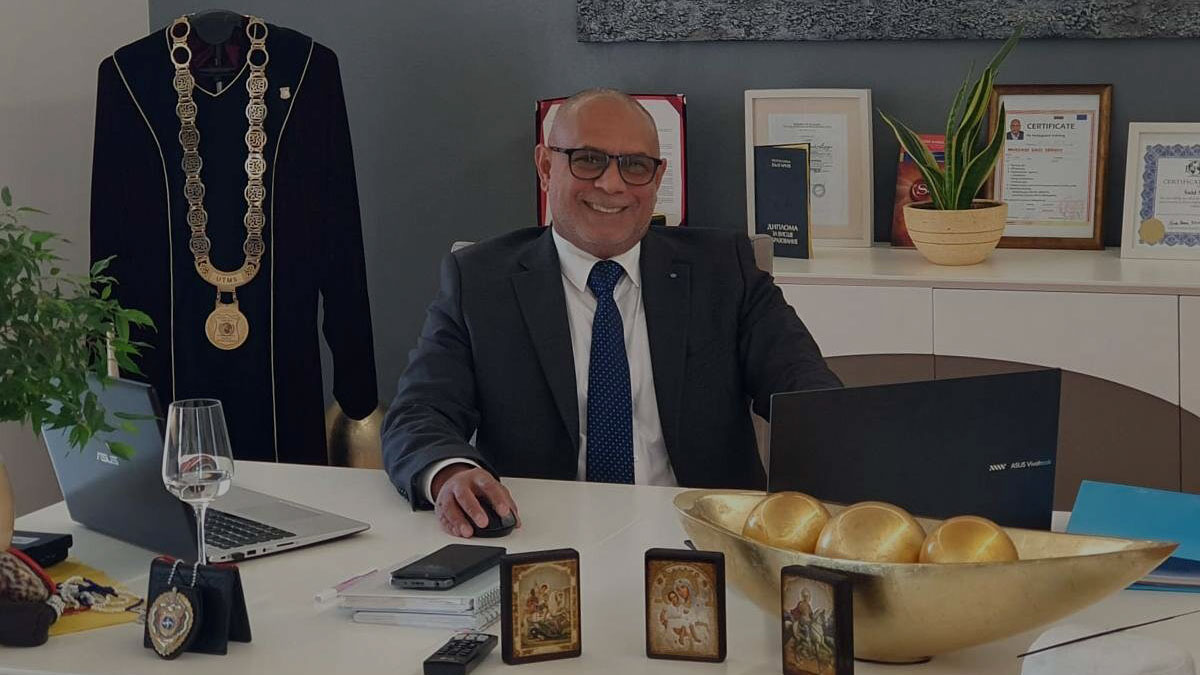
I will take this opportunity to thank Professor Ace Milenkovski and the entire academic team of the University for awarding me the title of “Doctor Honoris Causa”, the highest recognition that a University can bestow, in appreciation of my dedication and work over the years . This honorary degree not only filled my heart with satisfaction and joy, but also gave me additional motivation and energy to continue my work.
In fact, in Professor Ace Milenkovski, I recognize a highly developed vision for governance, capacity for leadership, experience, strategic thinking and commitment.
You have great experience and knowledge in the areas in which you are active, in the economy and in education. Behind us is an economically difficult year, full of challenges. How would you evaluate the current economic situation in the region, above all in Macedonia, which ended the year with inflation of nearly 15 percent?
We live in a global world. It is not difficult to govern a country that has two million inhabitants. The right mechanisms, politics, diplomacy, lobbying and long-term vision need to be applied. In the phase of pre-accession negotiations with the EU, it is important for your country to properly use structural funds and aid through the implementation of projects, appropriate rezoning and the creation of industrial zones to stimulate the economy and create growth, including in less populated areas.
Low inflation is healthy. But at a level close to 0 percent inflation, the economy of a country like Macedonia is unlikely to grow. Levels between 2 and 7 percent are considered ideal in the current context for many European countries. Higher levels, on the other hand, lead to the introduction of various measures for the country.
As a corporate, political and strategic consultant, I always advise to seriously consider those external factors that can cause higher inflation. It is necessary to implement quality control of public finances, proper management both at the micro and macro level and of public expenditures. I believe that strategic investments are key.
Macedonia has all the prerequisites to succeed and develop into a strong and prosperous European market economy. From a geographical point of view, the country has a mild climate, which with good management and marketing strategy is a prerequisite for the development of tourism and a favorable economic environment. In my opinion, it is important to create a decentralization commission. Speculative forces could have a detrimental effect on inflation, and the country must be careful to mitigate not only such an effect, but also corruption. It is also important to tackle poverty and inequality, which tend to widen over time if inflation and the poor purchasing power of the population are taken into account. They are not good in themselves at all because they also lead to corruption, lack of security, tensions and unrest among the population,
Macedonia is a stable country, has trade agreements with CEFTA and is a member of NATO, OSCE, UN, UNESCO, WTO, and all this has its advantages.
What, in your opinion, should the authorities in the country do to attract more foreign investors, in order to strengthen the economy in these crucial times?
Macedonia is well positioned, bordering five countries and all of them together could use that advantage in order to strengthen strategic alliances and the economies of the Balkans.
The government must emphasize strategies to increase the country’s visibility, including economic achievements, tourism and athletic development, macroeconomic growth factors that lead to economic progress, and administrative digitization. Smart cities, the best practices for public administration management, the division of institutional power, the possibility of online registration for small businesses and organizations, the digitization of all archives and registers, the automatic issuance of identification documents for permanent residents – all these possibilities give confidence to investors. . Like any developing economy, Macedonia needs foreign investment and workforce upgrading, which leads to economic growth. European investors demand that the government treat them with the same rights as the citizens of the country,
Therefore, no small or rural populated area should be left without water supply, municipal water supply, sewage system and waste water treatment system. For this, it is vital to take advantage of the Pre-Accession Assistance Programme.
Your country needs stable policies focused on innovative technologies and strategic investments in key sectors, in order to avoid dependence on other countries, especially in terms of food supply, renewable energy sources, technological modernization, education, tourism and marketing .
Regarding the political developments in the region, how do you comment on the current political situation in the Balkans, especially the relations between Skopje and Sofia, and how could these disagreements be overcome diplomatically?
The situation with the war in Ukraine is problematic for the whole of Europe, with harmful effects especially for the countries of the Balkan region. In my opinion, this war is an irreversible mistake, which has already left its mark on the division between future generations. I think a number of diplomatic and analytical mistakes were made, including those involving counterintelligence. In no way could the supply of arms lead to peace. Has anyone considered ordinary citizens, Russian and Ukrainian children, the economic consequences in neighboring countries and throughout Europe?
Regarding the developments between Skopje and Sofia, I have my own personal opinion, based on my knowledge of Balkan history and my many years of presence in the region. We all make mistakes. However, taking the same mistake from the past into the present does not bring anything positive for the development of nations, their economies and a visionary strategy for the future of their citizens. Citizens cannot be hostages to one or another error or historical interpretation for life, which, in turn, cannot be used to manipulate public opinion and to politically destabilize relations between the two countries.
Europe needs security in the Balkan region. The Macedonian people and business leaders want to be part of the EU as a full-fledged member state. This is my opinion.
Politicians should approach this work with maturity and mutual respect, to respect the economic and strategic interests and development of countries and their citizens, leaving aside any political or other interests and without losing their identity. The involvement of foreign statesmen who do not know the structure of the Balkans has cast doubt on the diplomatic capacity of those directly involved in the negotiations. One thing is certain – we need to focus on the future, because the past does not always bring good memories. The young generation expects that from us. Macedonia and Bulgaria will always be brotherly countries, and this should be the basis for building diplomatic and strategic relations, in order to achieve trust and cooperation, which will certainly be needed by both countries in the future.
Mr. Musagi, you have lived in the Balkans for many years. What do you like most about this region? Do you come to Macedonia often and what made the biggest impression on you about our country?
I have lived in the Balkans since 1994, when I was appointed by the then Minister of Foreign Affairs of Portugal, and later the President of the European Commission, José Manuel Durão Barroso, as Chancellor of the Embassy of Portugal in Sofia.
As a result of my professional duties, I had the opportunity to communicate with leaders from the entire Balkan region, including from Macedonia, and some of them are still my good friends and colleagues today.
In Macedonia, I had the opportunity to visit many places: besides Skopje, I also visited Kumanovo, Bitola, Prilep, Veles, Vinica, and everywhere I met friendly, unpretentious, intelligent, hardworking and ambitious people, who really care for their country. This leaves an impression.
I have many happy moments and experiences from my time in the Balkans – unforgettable sights with magnificent nature, rich history, and I can’t help but mention the delicious food and excellent wine.
With good governance, Macedonia can become a very rich country. Investment funds must be well spent. The country is not just highways, current communications are important for economic development, but it does not end there. The country must open its horizons to the outside world.
You see, Macedonia does not have a diplomatic representation in Portugal today, but, on the other hand, that is no reason not to visit Macedonia and feel well received by everyone here. I seek to bring Portuguese and other foreign investments to your country through the establishment of a Macedonian-Portuguese association.
It is important to create commercial and tourist zones, to invest in rural and agricultural regions. We need to prevent certain regions from falling into poverty based on an aging population because sooner or later this will become a problem.
It is not easy to express 29 years of professional and personal experience in Eastern European countries in a few sentences, but for me the most relevant is the strong feeling and connection I have with your country.